
Is Pilates good for lower back problems? Evidence & tips
TL;DR:
Pilates activates deep core stabilisers to improve spinal support and reduce back pain.
Evidence shows Pilates significantly lowers pain and disability in non-specific lower back pain.
Starting with professional guidance and gradual progression ensures safe, effective Pilates practice.
Lower back pain is one of the most common reasons people in Bedfordshire and Buckinghamshire seek help from a physiotherapist. The instinct to rest and wait it out is understandable, but research consistently shows that prolonged inactivity can actually make things worse. Pilates is frequently recommended as a remedy, yet many people remain unsure whether it genuinely works or whether it is simply fashionable advice. This article cuts through the uncertainty, drawing on current clinical evidence to explain how Pilates targets lower back pain, how it compares with other exercises, and how you can start safely.
Table of Contents
Key Takeaways
Point | Details |
Core activation benefits | Pilates strengthens deep core muscles, supporting better spinal stability and posture. |
Evidence for pain relief | Research shows Pilates reduces lower back pain and disability more than rest or minimal intervention. |
Comparable to other activities | Pilates is as effective as other exercises for back pain, with added benefits for posture and movement control. |
Safety and professional support | Pilates is generally safe, but expert guidance helps avoid injury and maximises results. |
How Pilates helps with lower back pain
Pilates is not simply a stretching class. It is a structured method of movement that targets the deep stabilising muscles of the trunk, which are often underactive in people with persistent lower back pain. Understanding why it works helps you commit to it with confidence.
The two muscles most relevant here are the transversus abdominis (the deepest abdominal layer, which acts like a natural corset) and the multifidus (small muscles running along either side of the spine). Both tend to weaken or switch off following a back injury, leaving the spine poorly supported. Pilates exercises specifically recruit these muscles before larger, more superficial muscles take over, restoring the stability your spine needs.
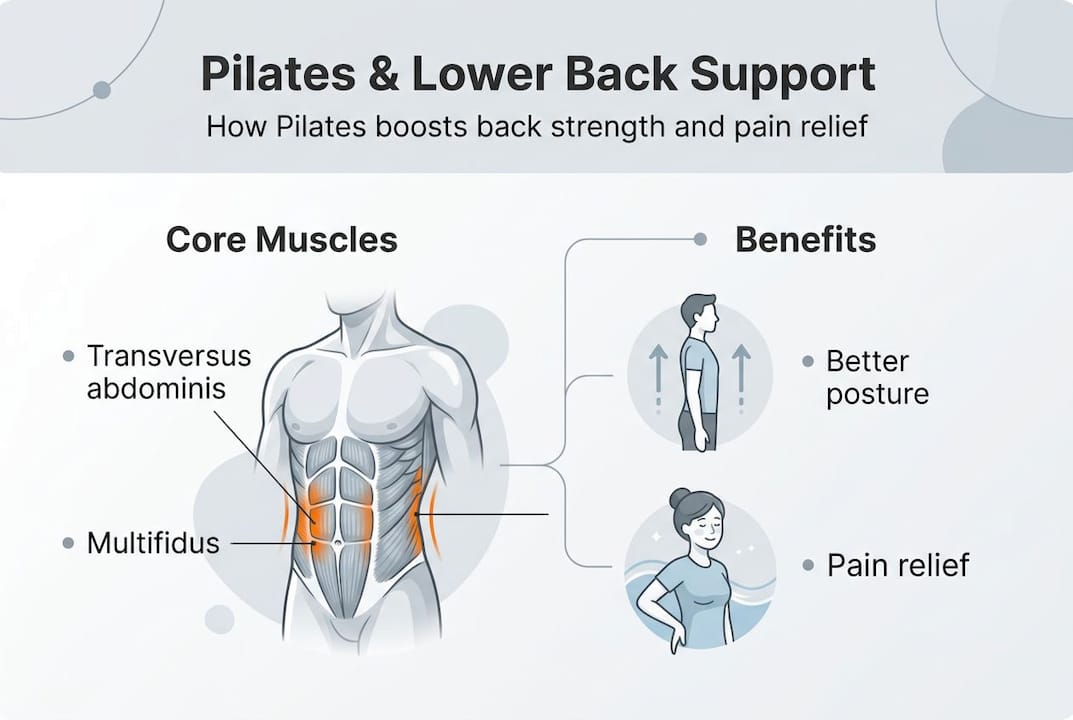
Beyond muscle activation, Pilates encourages better posture and controlled, deliberate movement. Many people with lower back pain develop compensatory habits, leaning to one side or bracing through the wrong muscles. Pilates retrains these patterns gradually, reducing the mechanical strain placed on spinal joints and discs. The role of Pilates in rehabilitation extends well beyond simple strengthening.
Breathing is another underappreciated element. Pilates uses lateral thoracic breathing (expanding the ribcage sideways rather than lifting the chest) to maintain core engagement during movement. This breathing pattern also activates the parasympathetic nervous system, which can reduce pain sensitivity and muscle tension.
Hip and spinal flexibility also improve with regular Pilates practice. Tight hip flexors and a stiff thoracic spine force the lower back to compensate, generating excess load. By improving mobility throughout the kinetic chain, Pilates reduces the burden placed on the lumbar region specifically.
Key benefits for lower back pain include:
Activation of deep stabilising muscles that support the spine
Improved posture and more efficient movement patterns
Reduced compensatory strain on lumbar joints and discs
Greater hip and spinal flexibility
Improved breathing mechanics and pain regulation
“Pilates works via core strengthening (deep stabilisers), improving spinal stability, posture, flexibility, and movement control.”
For those already using exercise as part of recovery, exploring Pilates for musculoskeletal recovery can offer a clear framework for progressing safely.
What does the evidence say about Pilates and lower back problems?
Knowing how Pilates works is useful, but what does the research actually prove? The evidence base has grown considerably in recent years, and the picture is genuinely encouraging.
A 2025 meta-analysis found that Pilates shows significant improvements in both pain and disability scores for people with non-specific lower back pain. Non-specific means the pain has no clear structural cause such as a fracture or tumour, which accounts for the vast majority of lower back complaints seen in clinical practice.
The numbers behind these improvements are worth examining. Studies report a mean difference (MD) of -1.14 on pain scales and -4.73 on the Oswestry Disability Index (ODI), a widely used measure of how much back pain limits daily activities. Both figures exceed the thresholds considered clinically meaningful, meaning these are real-world improvements that patients actually feel.
Outcome measure | Mean difference (MD) | Clinical significance |
Pain (VAS/NRS scale) | -1.14 | Clinically meaningful |
Disability (ODI) | -4.73 | Clinically meaningful |
Function (short-term) | Improved | Consistent across studies |
Quality of life | Improved | Moderate evidence |
A separate 2025 systematic review confirmed that Pilates outperforms other exercises for pain relief in chronic non-specific lower back pain. This is a notable finding because it positions Pilates not just as a reasonable option but as a potentially superior one when pain reduction is the primary goal.
The evidence is strongest for short to intermediate-term outcomes, typically up to three months. Long-term data is less robust, which is an honest limitation worth acknowledging. However, the short-term gains are consistent and meaningful, and they provide a strong foundation for ongoing activity.
For those managing their symptoms at home between appointments, a structured list of home exercises for lower back pain can complement a Pilates programme effectively.
Pilates versus other exercises: How does it compare?
With the research evidence clear, it is worth placing Pilates alongside other popular exercise options so you can make an informed choice that suits your lifestyle and preferences.
Exercise type | Strengths for lower back pain | Considerations |
Pilates | Core stability, posture, controlled movement | Requires instruction; cost varies |
Yoga | Flexibility, relaxation, stress reduction | Less targeted core activation |
Walking | Accessible, low cost, improves circulation | Less specific to deep stabilisers |
Generic physiotherapy exercises | Tailored to individual, evidence-based | Requires professional input |
Swimming | Low impact, whole-body conditioning | Access and cost may be barriers |
It is important to be honest: Pilates is not conclusively superior to all other exercises in every situation. Walking, yoga, and general physiotherapy exercises can all reduce lower back pain meaningfully. The best exercise is often the one you will actually do consistently.
That said, for people with subacute lower back pain (pain lasting between six weeks and three months), Pilates was superior to home exercises for both pain reduction and quality of life at the end of treatment and at a three-month follow-up. This makes it a particularly strong choice during that critical window when the back is healing but still vulnerable.
Factors that might lead you towards Pilates specifically include:
A preference for structured, guided sessions
A history of recurring back pain that suggests poor core stability
Difficulty sticking to unguided home exercise routines
A desire to improve posture alongside pain management
For guidance on how different physiotherapy types and preferences influence treatment choices, it is worth speaking with a qualified physiotherapist who can assess your specific situation.
Pro Tip: If you are unsure whether Pilates or another exercise suits you, try a single supervised session before committing to a full programme. A good instructor will assess your movement and tell you honestly whether Pilates is the right fit.
How to get started with Pilates safely
Once you have decided to try Pilates, starting correctly makes a significant difference to both your safety and your results. Here is a practical sequence to follow.
Consult a physiotherapist or GP first. Before joining any class, get a professional assessment. This confirms that Pilates is appropriate for your specific type of back pain and rules out any red flags that require medical investigation.
Choose a qualified instructor with rehabilitation experience. Not all Pilates teachers have the same training. Look for someone with a recognised qualification and experience working with back pain patients, rather than a general fitness instructor.
Start with foundation exercises. Basic movements such as pelvic tilts, knee folds, and the dead bug position build the neuromuscular connection between your brain and your deep stabilisers. These are not glamorous, but they are the foundation everything else rests on.
Progress gradually. Increasing difficulty too quickly is the most common mistake. Your nervous system needs time to learn new movement patterns, and your muscles need time to strengthen. Patience here pays dividends.
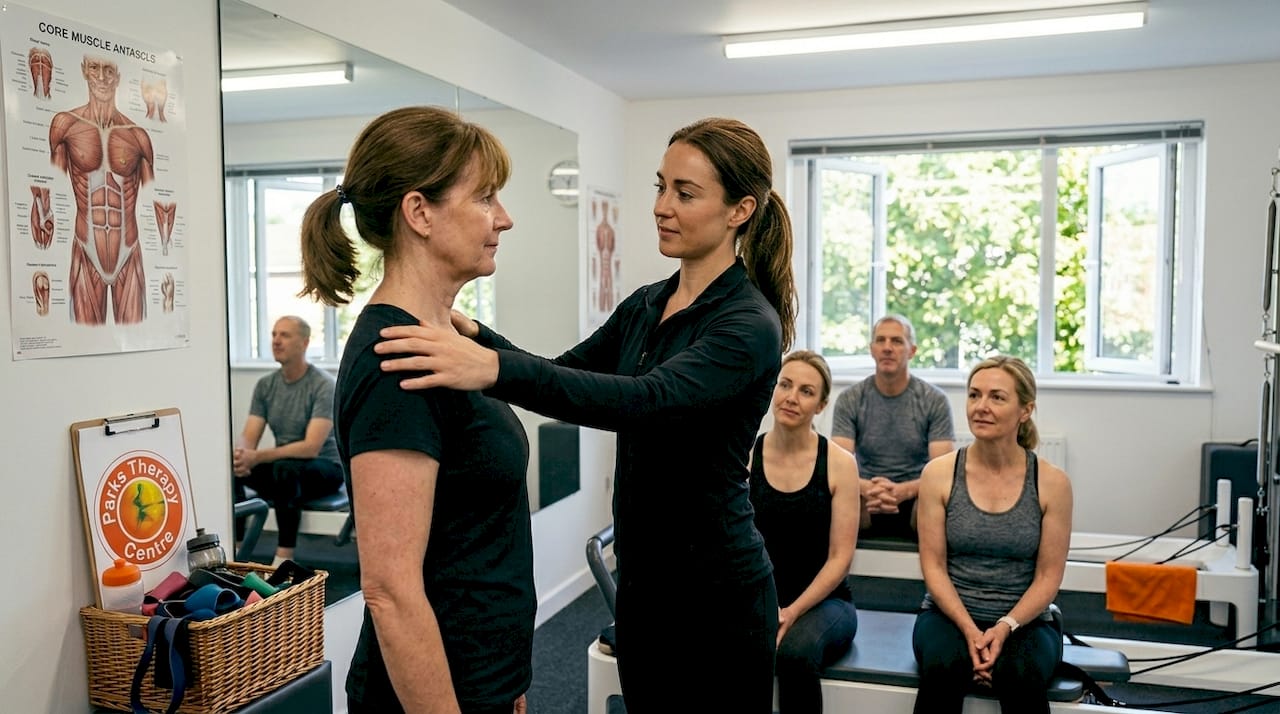
Attend one-to-one sessions initially. Group classes are cost-effective, but individual sessions allow an instructor to correct your technique in real time. Even two or three individual sessions before joining a group class can dramatically improve your outcomes.
Listen to your body. Mild muscle fatigue is normal. Sharp, shooting, or worsening pain is not. Stop and seek advice if anything feels wrong.
The good safety profile of Pilates means serious adverse events are rare, but technique matters. Poor form can load the spine incorrectly, which is why professional guidance is so valuable at the start.
For broader advice on starting any new exercise-based recovery, the beginner physiotherapy recovery tips on our website offer a useful companion guide.
Pro Tip: Wear comfortable, close-fitting clothing to your first session so your instructor can see your alignment clearly. Baggy clothing makes it much harder to spot and correct technique errors.
Why Pilates is valuable and what most advice overlooks
Here is something most articles on Pilates will not tell you: the method itself matters far less than most people think. People spend a great deal of time debating Pilates versus yoga versus physiotherapy, when the real determinant of success is consistency and quality of instruction.
We see this regularly in clinical practice. A patient who attends a well-taught Pilates class twice a week for three months will almost always outperform someone who dabbles across four different methods without ever committing. The multimodal approach is valuable, but only when each component is done well and sustained over time.
The other overlooked factor is expectation management. Pilates is not a cure. It is a tool. If you approach it expecting complete pain elimination within a fortnight, you will likely give up before the benefits accumulate. If you approach it as a long-term investment in spinal health, you will stay the course.
Our view, shaped by years of working with back pain patients across Bedfordshire and Buckinghamshire, is that the best outcomes come from combining Pilates with professional physiotherapy assessment, lifestyle adjustments, and realistic goals. Choosing the right physiotherapy techniques alongside Pilates is what separates short-term relief from lasting change.
Discover expert support for your recovery
If you are ready to take action on your lower back pain, professional guidance makes all the difference between a programme that works and one that stalls.
At Parks Therapy Centre, our experienced physiotherapists and Pilates specialists work with patients across Bedfordshire and Buckinghamshire to create tailored recovery programmes. Whether you are dealing with acute pain, a recurring problem, or simply want to build a stronger, more resilient back, we can help you start safely and progress with confidence. Book a consultation today and let us design a programme built around your specific needs.
Frequently asked questions
Is Pilates better than yoga for lower back pain?
Pilates tends to offer stronger core stability benefits, while yoga focuses more on flexibility and relaxation. Research confirms that Pilates outperforms other exercises for pain relief in chronic non-specific lower back pain, though both approaches have genuine value.
Can I do Pilates if I have severe lower back pain?
You should speak with a physiotherapist or GP before starting Pilates with severe back pain. The good safety profile of Pilates is well established, but professional assessment ensures the exercises are appropriate for your specific condition.
How soon can I expect improvements from Pilates for back pain?
Meaningful pain and mobility improvements can begin within a few weeks of consistent practice. Most clinical evidence covers short to intermediate-term results, with Pilates superior to home exercises for pain and quality of life at three-month follow-up.
Are there any risks or side effects with Pilates?
Pilates carries a good safety profile with only minor adverse events reported in research. Poor technique or overexertion can aggravate symptoms, which is why starting with a qualified instructor is strongly advised.
Recommended